









 Belagavi district politics has long been influenced by the formidable Jarkiholi family, a name synonymous with political strength and grassroots influence in North Karnataka. At the forefront of this political network stands Satish Laxmanrao Jarkiholi, a leader who has steadily expanded his influence from the cooperative sector to the highest levels of state politics.
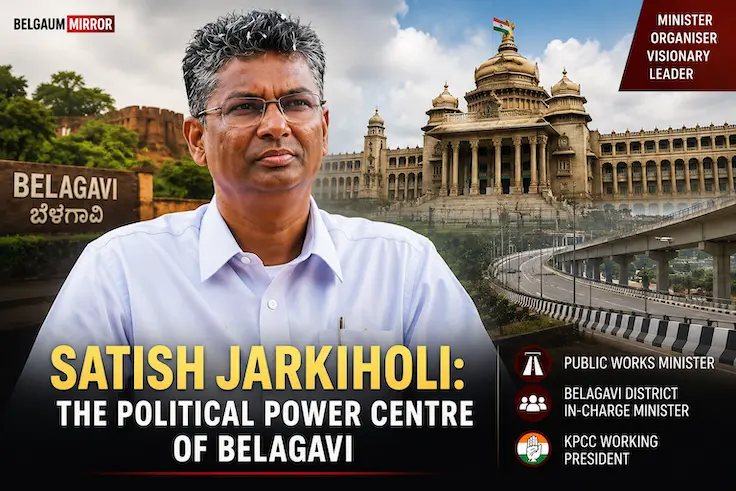
Born on June 1, 1962, in Gokak, Satish Jarkiholi belongs to the Valmiki Scheduled Tribe community. A farmer, entrepreneur and politician, he currently represents the Yamakanmardi Assembly constituency and serves as Karnataka’s Public Works Minister, Belagavi District In-charge Minister and Working President of the Karnataka Pradesh Congress Committee (KPCC).
Satish Jarkiholi’s public life began in 1992 when he was elected as a director of the Belagavi District Central Cooperative (DCC) Bank. In Belagavi, the DCC Bank has traditionally been more than a financial institution; it has often served as a key platform for political influence and leadership development. His growing network in the cooperative sector paved the way for his entry into legislative politics.
From 1998 to 2008, he served as a Member of the Karnataka Legislative Council, establishing himself as an important Congress leader in the region. His political journey gained further momentum when he entered electoral politics in the Yamakanmardi constituency.
Yamakanmardi has emerged as Satish Jarkiholi’s strongest political bastion. He won the Assembly election from the constituency for the first time in 2008 and successfully retained the seat in 2013, 2018 and 2023. Political observers often attribute his continued success to a combination of strong organisational networks, community outreach, local influence and a development-focused approach.
His ministerial career began in 2004 when he entered the state cabinet as Minister of State for Textiles. Over the years, he has handled several important portfolios, including Excise, Forest and Environment, and Public Works. As the current Public Works Minister, he oversees key infrastructure projects involving roads, bridges and public buildings across Karnataka.
One of the rare setbacks in his political career came during the 2021 Belagavi Lok Sabha by-election. Contesting as the Congress candidate, he lost to Mangala Suresh Angadi by a margin of 5,240 votes. Despite the defeat, his influence within district politics and the Congress organisation remained largely intact, and he continued to play a prominent role in state and regional political affairs.
The Jarkiholi family continues to hold considerable influence in Belagavi’s political landscape. Family members occupy important positions across different political spheres. Among them are Ramesh Jarkiholi, Balachandra Jarkiholi, Lakhan Jarkiholi and Priyanka Jarkiholi. Even when family members are aligned with different political parties, their collective influence continues to shape district-level political equations.
Beyond politics, Satish Jarkiholi is associated with the sugar industry and agriculture-based enterprises in North Karnataka. His interests reportedly extend to sugar mills, ethanol production and related industrial ventures. His close connection with sugarcane farmers has strengthened his support base in rural areas and contributed significantly to his political standing.
Satish Jarkiholi is also regarded as one of the prominent Valmiki community leaders in Karnataka. He has frequently raised issues concerning Scheduled Tribe rights, reservation policies, education and employment opportunities. Within the Congress party, he is considered an important pillar of the AHINDA social coalition championed by Chief Minister Siddaramaiah, particularly in North Karnataka.
Apart from his electoral and organisational roles, Satish Jarkiholi is known for his ideological positions and advocacy of rationalist thought. Through the Manava Bandhutva Vedike, he has supported campaigns against superstition and promoted scientific temper. His annual observance on December 6, which includes spending time in a cremation ground to challenge social myths and superstitions, has drawn attention across Karnataka and remains one of the most distinctive aspects of his public persona.
Over three decades after entering public life, Satish Jarkiholi remains one of the most influential political figures in Belagavi district, combining organisational strength, electoral success, social outreach and ideological activism to maintain his position at the centre of the region’s political landscape.