












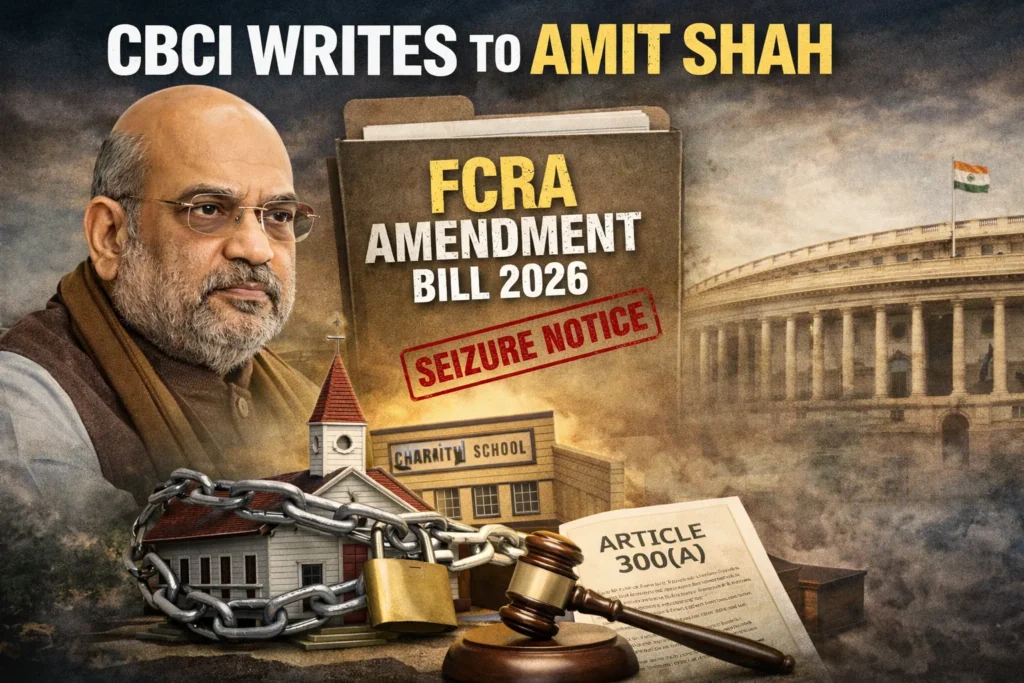
The Catholic Bishops’ Conference of India has urged Union Home Minister Amit Shah to refer the proposed Foreign Contribution (Regulation) Amendment Bill, 2026 to a Parliamentary committee, warning that key provisions could undermine constitutional safeguards and civil society functioning.
The appeal comes ahead of the Bill’s scheduled passage in the Lok Sabha, with the Church body calling for wider consultation and legislative scrutiny.
Concerns Over Asset Seizure and Constitutional Rights
In a memorandum submitted to the Home Minister and Members of Parliament, CBCI Secretary General Anil J. T. Couto raised objections to provisions that allow the government to take over assets created using foreign funds if an organisation’s FCRA licence is cancelled, surrendered, or lapses.
The memorandum argues that such provisions may violate Article 300A of the Constitution, which guarantees the right to property and mandates that deprivation must be just, fair, and reasonable. It also highlights the absence of prior judicial oversight before asset vesting, calling it a departure from due process.
Also Read: Belagavi Census 2027: Self-Enumeration Process Begins from April 1
Proposed Changes and Their Impact
The 2026 amendment introduces a new framework where foreign contributions and assets created from them would vest in a designated authority in cases of licence cancellation, surrender, or non-renewal.
The CBCI has warned that this could disproportionately affect long-standing charitable institutions that have built infrastructure over decades using foreign contributions. Many such organisations now rely less on foreign funds but continue to operate essential services using these assets.
The memorandum further points out that renewal of FCRA registration is entirely controlled by the government, and organisations are often not informed about deficiencies or given an opportunity to respond before denial.
Impact on Charitable and Faith-Based Institutions
The Church body cautioned that the Bill could affect constitutional protections under Articles 25 and 26, which guarantee religious freedom and autonomy. It stressed that faith-based organisations play a critical role in education, healthcare, and social outreach, particularly among vulnerable communities.
It warned that excessive regulatory control could disrupt these services, ultimately impacting millions of beneficiaries rather than the institutions themselves.
Also Read: Belagavi Milk Union Posts ₹12.59 Crore Profit, Achieves ₹510 Crore Turnover
Call for Safeguards and Wider Consultation
The CBCI has recommended that the Bill be referred to a Parliamentary Standing Committee for clause-by-clause review. It has also called for safeguards to ensure due process, judicial oversight, and protection against disproportionate penalties such as asset seizure.
The memorandum emphasizes the need for an independent appellate authority to ensure fair adjudication and grievance redressal.
Local Context: Why It Matters for Belagavi
Belagavi and surrounding regions host several educational, healthcare, and social service institutions run by faith-based and charitable organisations. Any regulatory changes affecting foreign funding and asset control could have direct implications for these institutions and the communities they serve.
With many such organisations working in rural outreach, education, and healthcare, stakeholders in North Karnataka will be closely watching developments in Parliament.