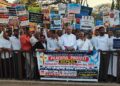








Jan 13: Belagavi-based Citizens Council on Tuesday submitted a detailed memorandum to Bhushan G. Borase, Commissioner of Police, urging immediate restrictions on the movement of heavy vehicles within city limits during peak daytime hours, citing serious concerns over traffic congestion and public safety.
The representation highlighted that the ongoing construction work at the 3rd and 4th Railway Gates has resulted in their closure, forcing all vehicular movement to be diverted through the 1st and 2nd Railway Gates on Congress Road. These two crossings currently serve as the primary connectivity between the eastern and western parts of Tilakwadi, while also linking major areas such as Udyambag, MLIRC Camp, and the central parts of the city. As a result, the stretch remains heavily congested for most of the day.
The memorandum was submitted by Satish Tendulkar, Basavraj Javali, Vikas Kalghatgi, Mukesh Khoda, Nitesh Jain, and Raju Paliwala, who personally met the Police Commissioner on January 13. In it, this Council pointed out that Belagavi has a dense concentration of traffic-sensitive institutions and public utilities along this corridor. The area accommodates more than 17 schools and over 20 colleges, several major hospitals, busy commercial establishments, theatres, malls, hotels, and restaurants. The Belagavi Railway Station, located within city limits, sees over 28 long-distance trains daily, leading to frequent gate closures that further disrupt traffic flow.
The council also drew attention to the presence of Udyambag, the city’s largest industrial hub, where more than 10,000 workers commute daily, mostly via Congress Road. Adding to the pressure are two major city bus stands, over 23 bus shelters, and a rapidly increasing number of vehicles, including more than 10,000 auto-rickshaws, over 80,000 private cars, and nearly 1.5 lakh two-wheelers on city roads every day.
According to the memorandum, the convergence of students, patients, ambulances, industrial workers, public transport, pedestrians, and heavy vehicles on narrow city roads has created an extremely unsafe environment. The council cited recent major accidents as a stark reminder of the risks involved, noting that such incidents have become increasingly frequent on Belagavi roads.
The Citizens Council warned that the unrestricted movement of heavy vehicles through these critical city corridors often blocks emergency vehicles and ambulances, endangers schoolchildren and patients, and causes prolonged traffic snarls during railway gate closures. It also pointed to damage to road infrastructure and rising air and noise pollution in sensitive zones as additional concerns.
In view of the prevailing situation, the council urged the police department and district administration to impose an immediate or time-based ban on heavy vehicles within Belagavi city limits. It specifically sought a complete restriction on the movement of heavy vehicles along Congress Road, particularly near railway crossings and hospital zones, and called for their mandatory diversion to bypass roads and outer routes. The memorandum also stressed the need for special traffic regulation near schools, colleges, hospitals, and railway crossings, along with strict enforcement by traffic police and RTO authorities.
Emphasising the urgency of the matter, the council stated that ongoing railway gate construction, high traffic density, and repeated accidents make immediate administrative intervention crucial to safeguard lives and ensure smoother traffic movement across the city.